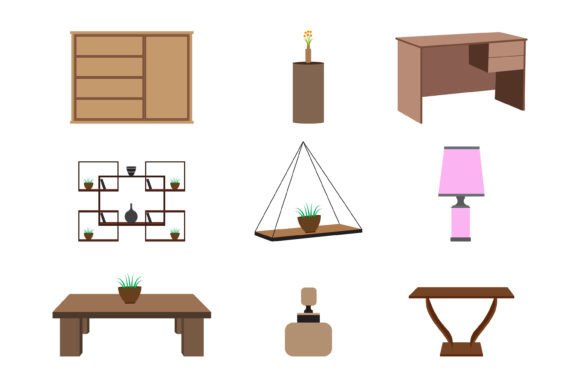
Home Decor Interior Furniture Elements I Graphics & Print Templates
First Impressions: Cozy, Curated, and Quietly Elegant
When I opened Home Decor Interior Furniture Elements I, I immediately felt that familiar spark—the kind you get when a design asset *just fits* your handmade aesthetic. It’s not loud or trendy in a fleeting way; it’s warm, intentional, and quietly sophisticated—think soft linens, curated bookshelves, minimalist plant stands, and vintage-inspired armchairs rendered with clean lines and gentle negative space. This isn’t clipart for kids’ rooms or hyper-bright party decor. It’s for the maker who sells linen tea towels on Etsy, hand-pours soy candles with “Cozy Corner” labels, or designs printable wall art for mindful home offices. The mood is calm, collected, and deeply wearable across seasons—equally at home in spring refresh bundles or cozy fall gift sets.
Where It Shines in Real Crafting Workflows
I tested Home Decor Interior Furniture Elements I across six active projects last month—and it delivered every time. For my Cricut project building custom ceramic mug decals, the SVG design scaled beautifully from 2.5" to 4.5" without jagged edges or stray anchor points. On white mugs? Crisp and inviting. On matte black tumblers? Subtle but legible—especially when paired with a thin sans serif font like Montserrat Light. As a Silhouette project for vinyl-cut tote bags, the clean outlines cut flawlessly on 60-micron removable vinyl, and the grouping logic (each furniture piece as its own layer) saved me 15 minutes per bag when prepping files.
It’s also become my go-to for printable product lines: I used the PNG design with transparent background to build a set of 8.5" × 11" printable wall art sheets (3 per page), then added subtle watercolor texture overlays in Canva before listing them as instant-download Etsy products. Customers love that they can print at home *or* send to a local print shop—the resolution holds up even at 300 DPI. And for planner stickers? I resized three elements (a reading nook chair, a floor lamp, and a stack of books) into 1"–1.5" versions, exported as PNGs with crisp anti-aliasing, and printed them on kiss-cut sticker paper. They peeled cleanly and stuck reliably on both glossy and matte planner pages.
Best Uses: From Bundles to Branding
- Seasonal craft bundles: Paired with neutral-toned botanical clipart, it formed the backbone of my “Spring Refresh Kit”—digital download + physical sample pack for craft fair shoppers.
- Gift products: Used on kraft gift tags, reusable cotton drawstring bags, and folded thank-you cards for handmade candle orders.
- Printable designs: Works especially well in grid-based layouts—think 4×4 photo collages for nursery walls or framed “My Reading Nook” printables.
- Small business branding: I adapted one simplified armchair icon as a subtle watermark on my wholesale order forms and packaging inserts—soft, professional, and on-brand.
- Product mockups: Dragged the PNG design straight into Placeit templates for Instagram listings—no clipping masks needed thanks to perfect transparency.
Where to Proceed With Care
Not every element translates equally. The detailed bookshelf illustration has fine shelf lines that vanish below 1.25" in sticker size—so I avoided using it for 0.75" planner stickers entirely. Also, the layered rug pattern (though beautiful) includes overlapping semi-transparent shapes that don’t always separate cleanly in Cricut Design Space—so I ungrouped and flattened it before cutting vinyl. If you’re planning sublimation design for ceramic coasters, test the grayscale values first: some shadow tones compress into near-black and lose dimension on light substrates. And while the color palette is versatile, avoid placing the darkest navy elements directly on dark apparel unless you’re using glitter or foil vinyl—it’ll disappear on heather grey tees without contrast testing.
Practical Crafter Notes You’ll Actually Use
- Always open the SVG design in a vector editor first—check for stray points or compound paths that could confuse your Cricut or Silhouette machine.
- Preview the PNG design at 100% zoom: confirm transparency is fully clean (no gray halos) before dropping into Canva or Photoshop.
- For sublimation design, verify the file is 300 DPI at intended print size—and convert to CMYK if your printer requires it.
- Test print on both white and dark cardstock: some mid-tone greys look warm on ivory but cool on charcoal.
- Place Home Decor Interior Furniture Elements I on real mockups—not just digital previews—before listing. A chair icon looks balanced on a mockup tumbler wrap but can feel top-heavy on a narrow mug handle.
- Simplify when scaling down: delete tiny decorative details (like cushion stitching) for anything under 2".
- Pair with fonts intentionally: serif (Cormorant Garamond) for elegance, rounded sans (Quicksand) for approachability, or delicate script (Pacifico) for feminine gift tags.
- Double-check the commercial license—this graphic design asset permits use in physical handmade products and digital downloads, but *not* resale as standalone clipart or inclusion in design bundles you redistribute.
Why This Fits Real Handmade Business Needs
Home Decor Interior Furniture Elements I doesn’t try to be everything. It’s focused, refined, and built for makers who value consistency over clutter. Whether you’re launching a new line of printable home organization kits, prepping for a holiday craft fair, or fulfilling custom Cricut project requests for local clients, this asset saves hours—not just in design time, but in decision fatigue. It’s the quiet confidence of knowing your mug design, sticker sheet, or Etsy banner all speak the same visual language. In a creative marketplace crowded with generic florals and overused quotes, it’s a breath of intentional air. And for handmade business owners? That kind of cohesion—across products, platforms, and seasons—is pure small business branding gold.